Garage Conversion ADU vs Detached ADU: Which Is Better for Your Property?
If you want to add independent living space to your property, two common options are converting an existing garage or building a detached ADU in the yard.…
If you want to add independent living space to your property, two common options are converting an existing garage or building a detached ADU in the yard. Both can create a home for family or a potential rental. The right fit depends on the condition of your garage, the space available, your budget, and how you want the property to work.
Here's how to compare the options before you choose a direction.
At a glance
| Garage conversion ADU | Detached ADU | |
|---|---|---|
| Uses | An existing garage structure | A new, separate structure |
| Typical cost | Often lower if the garage is in good condition | Often higher because it involves new construction |
| Layout flexibility | Limited by the existing footprint and structure | More freedom to plan size, layout, windows, and entry |
| Privacy | Depends on the garage's location and access | Can be sited to create more separation from the main home |
| Parking | You give up the garage; replacement parking generally isn't required by state law when a garage is converted to an ADU | You may be able to keep an existing garage, subject to site layout |
| Main question | Can the existing structure be made suitable for a home? | Is there a workable location for a new unit? |
These are general comparisons, not a property-specific assessment. Local requirements, existing conditions, and the scope of work can change the picture.
What is a garage conversion ADU?
A garage conversion ADU turns some or all of an existing garage into independent living space. The finished unit needs approved living, sleeping, cooking, and bathroom facilities. A conversion may preserve the basic footprint and much of the existing structure, but it still needs to meet applicable building, health, and safety requirements.
That can mean work on insulation, windows, walls, the roof, the floor, electrical service, plumbing, heating and cooling, and fire safety. The extent depends on how the garage was built and what the plans call for. An existing slab or roof may be useful, but their condition and suitability need to be assessed rather than assumed.
California's ADU Handbook explains the state framework for conversions and new ADUs. For San Bernardino County, the county confirms that converting a garage to an ADU does not require replacement off-street parking under its garage conversion guidance. Check with the agency that serves your property, since you may live in a city rather than an unincorporated county area.
What is a detached ADU?
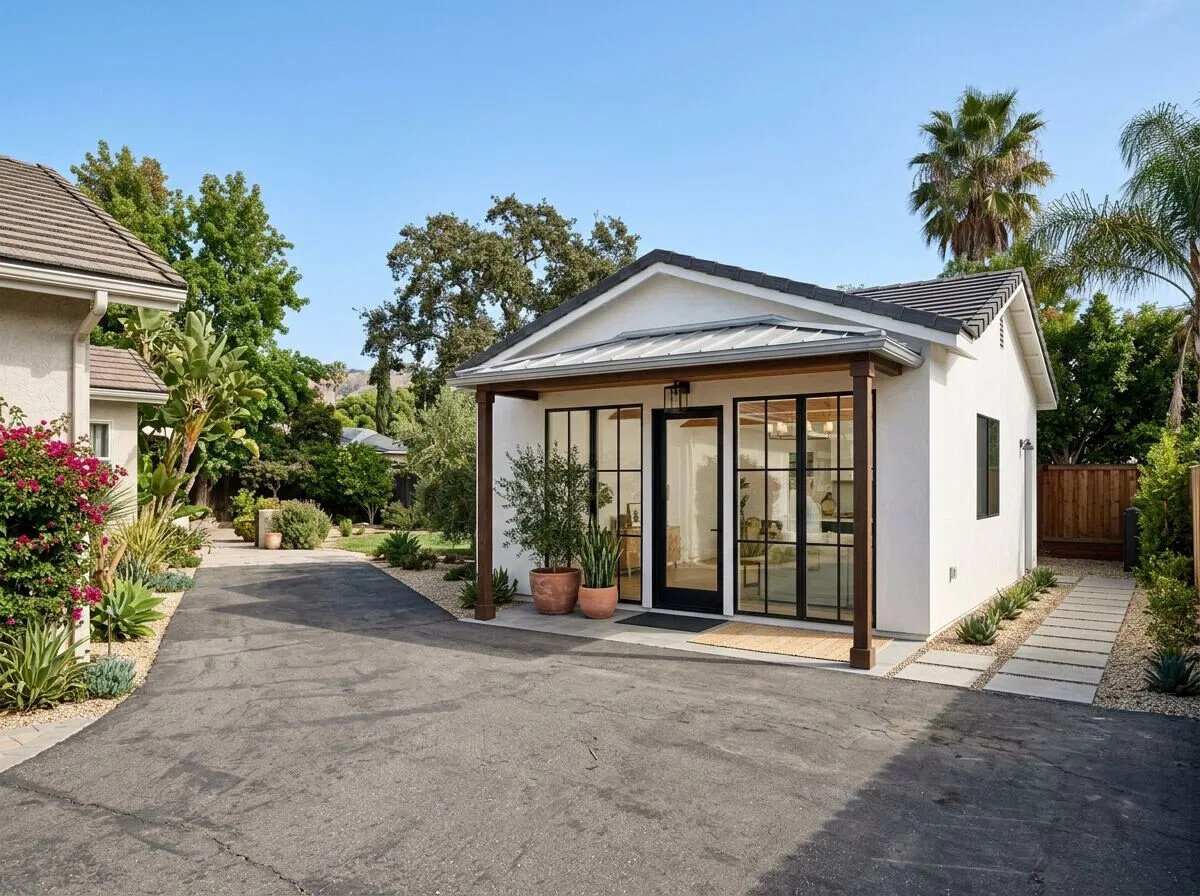
A detached ADU is a separate home built elsewhere on the lot. Because it is new construction, its layout and placement can be designed around the intended use, privacy, access, and the space available. Depending on the project, it may need new foundation work, utility connections or extensions, grading, drainage, and landscaping.
A detached unit can make sense when you want to keep using your garage or when converting it would require extensive repairs. It may also give you more room to design a separate entrance and a distinct outdoor area. In exchange, you'll need a suitable location on the property and a construction plan that accounts for site access and utility routes.
Compare the costs realistically
A garage conversion is often the lower-cost path because it may make use of an existing structure. But “existing” does not necessarily mean “ready to convert.” If the garage needs substantial structural, moisture, utility, or code-related work, those costs can narrow the difference.
Detached construction generally costs more because it involves building a new structure and preparing the site. The budget can include foundation and framing, utility work, design and engineering, permits, finishes, appliances, and site work.
Published Southern California estimates vary widely. As an initial planning range, some estimates place permitted garage conversions around $100,000–$160,000 and detached ADUs around $220,000–$350,000. These are broad market estimates, not bids or guaranteed prices. The unit's size and finish level, existing conditions, utility needs, and local fees can all affect the final budget. For context, review estimates from Dynamic Quality Builders and GreatBuildz, then get a project-specific proposal.
When comparing proposals, look beyond the headline total. Ask what's included, what's excluded, how allowances are handled, and which items depend on further site or design review. Permit and impact fees, utility work, appliances, and landscaping may be treated differently from one proposal to another. A written scope helps you compare options on the same basis.
For a deeper look at ADU planning, you can also read Terra Nostra Builders' Inland Empire ADU overview.
Consider the timeline, not just construction days
Both options require planning, drawings, permit review, construction, and inspections. A straightforward conversion may involve less new site work, but the work can expand if inspection reveals that the existing garage needs significant upgrades. A detached ADU usually has additional new-construction steps, including site preparation and foundation work.
California law generally requires a permitting agency to approve or deny a complete ADU application within 60 days. That is a review deadline, not a promise that design, corrections, utility coordination, construction, and inspections will all be finished within 60 days. The clock and process depend on a complete submittal and the agencies involved. Riverside County, for example, provides information about its Permit Ready ADU process.
As a broad planning estimate, homeowners may need to allow several months for design and permitting, followed by several months of construction. The schedule can shift with project complexity, review comments, contractor scheduling, material availability, and site conditions. Your contractor should explain the expected sequence and identify what could affect it.
Check the property before choosing
A site review can help answer whether a conversion or detached unit is more practical. Consider these questions:
For a garage conversion
- Is the garage's foundation, framing, roof, and floor in suitable condition?
- Can the space accommodate a functional layout, including natural light, ventilation, and an entrance?
- Where could the kitchen and bathroom connect to plumbing and utilities?
- Are you comfortable giving up the garage for parking or storage?
For a detached ADU
- Is there enough usable yard space for the unit and access to it?
- How far will utilities need to run?
- Can construction equipment and materials reach the proposed build area?
- How would the unit affect privacy, outdoor space, and circulation around the main home?
The rules depend on the parcel and its jurisdiction. An ADU on a property in a city may be reviewed by that city, while an unincorporated property may fall under county departments. Confirm the applicable zoning, building, fire, and utility requirements before settling on a design.
Which option may fit your goals?
A garage conversion ADU may be worth exploring if the structure is in good condition, the footprint suits your intended use, and you're ready to give up the garage. It can be a practical way to use space that's already there, though the existing layout and condition will shape what's possible.
A detached ADU may be a better fit if you want to keep the garage, need a different layout, or want more separation between the two homes. It generally involves more new construction and site planning, but also gives you more freedom to shape the unit around your needs.
Neither option guarantees a particular rental income or increase in property value. Those outcomes depend on the completed unit, local demand, project costs, and other circumstances. If rental use is part of your plan, consider likely rent alongside financing, insurance, maintenance, utilities, and vacancy.
Start with the property and your priorities
Before choosing a design, identify who will use the ADU, what you want it to include, and which parts of the property you need to preserve. Then compare the condition and location of the garage with the available space for a detached unit. That early review can help you understand which option deserves further design and cost planning.
Terra Nostra Builders, Inc. serves Rancho Cucamonga and the Inland Empire with ADU construction, garage conversions, and garage replacements. We can review your property, discuss your goals, and help you explore a scope and estimate based on the project. Details depend on site conditions and the requirements that apply to your location.
If you're considering a garage conversion ADU or a detached unit, contact Terra Nostra Builders for an initial conversation. There's no need to choose a direction before you understand what your property may support.
Terra Nostra Builders, Inc.
California general contractor · CSLB #1132769
Frequently asked questions
Does converting a garage into an ADU require replacing the parking spaces?
In California, converting a garage to an ADU generally does not require replacement off-street parking under state law, and San Bernardino County confirms this for its unincorporated areas. Rules can vary by city, so confirm with the agency that serves your property.
Which is cheaper: a garage conversion ADU or a detached ADU?
A garage conversion is often the lower-cost path because it can make use of an existing structure, with broad Southern California estimates around $100,000 to $160,000 versus roughly $220,000 to $350,000 for a detached ADU. Actual costs depend on the garage’s condition, site work, utilities, and finishes, so a project-specific proposal is essential.
How long does it take to build an ADU in the Inland Empire?
Plan on several months for design and permitting followed by several months of construction. California law generally requires a permitting agency to act on a complete ADU application within 60 days, but that covers the review only, not design or construction.
Will a garage conversion ADU add rental income or property value?
A finished ADU can create rental potential, but neither option guarantees a particular income or increase in property value. Outcomes depend on the completed unit, local demand, and project costs, so consider rent alongside financing, insurance, maintenance, and vacancy.