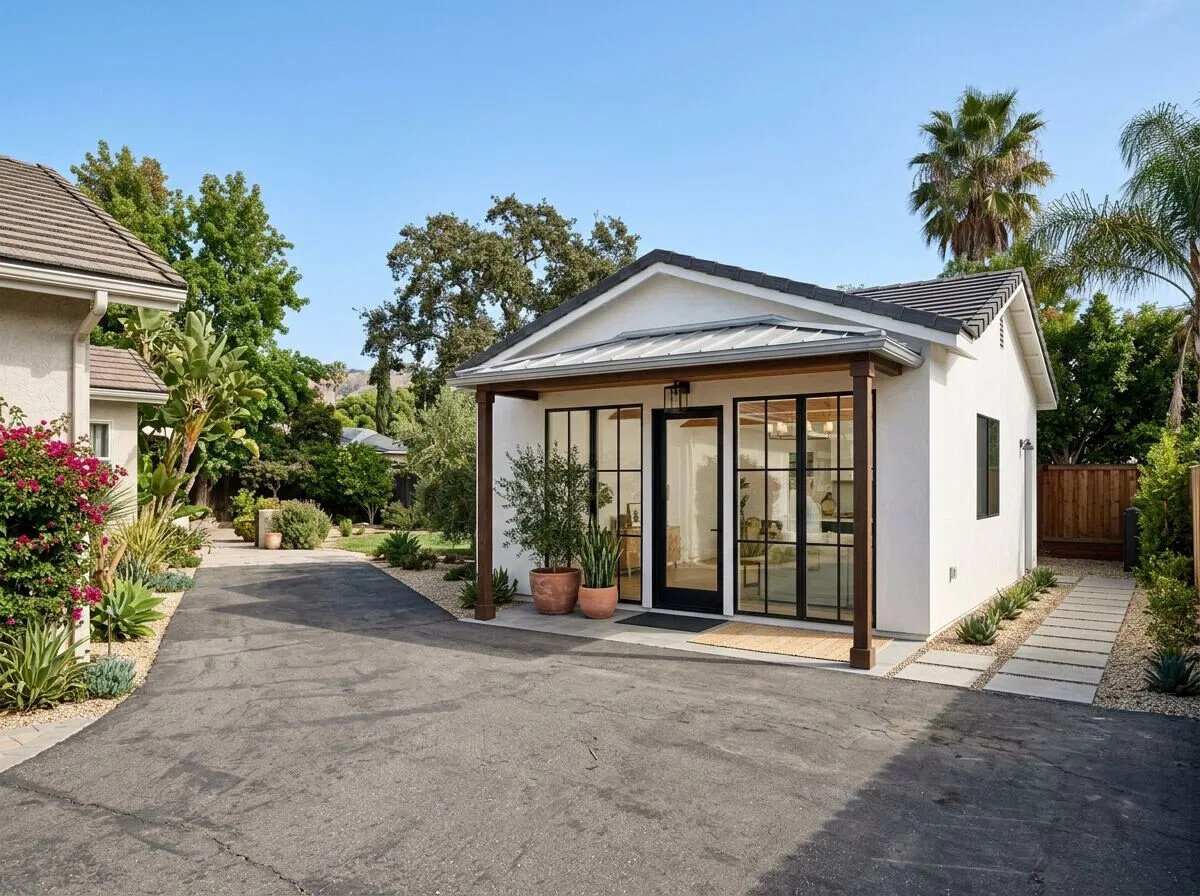
How Casitas and Little Houses Are Taking On California's Housing Crisis in 2026
A small home in the backyard can’t fix California’s housing shortage on its own. But a permitted accessory dwelling unit (ADU): sometimes called a casita,…
A small home in the backyard can’t fix California’s housing shortage on its own. But a permitted accessory dwelling unit (ADU): sometimes called a casita, backyard cottage, or “little house”, can add a place to live without requiring a separate lot.
For some households, that space means a home for a parent or adult child. For others, it may offer a potential rental or a way to make better use of a property they already own. In 2026 and 2027, state policy changes are also making it easier to explore some ADU projects.
For Inland Empire homeowners, the practical question is not whether ADUs will solve the crisis. It’s whether your property could support a useful, well-planned home, and who it could serve.
A small home can add housing close to home
California’s ADU permitting has grown sharply since statewide reforms began. The state’s housing department reports that annual ADU permits increased from 1,336 in 2016 to 26,924 in 2023, about twenty times as many. Revised reporting puts 2024 permits at roughly 39,000. These are permits, not a count of completed homes or a measure of how affordable each one is. (California HCD ADU Handbook; 2024 permit data summary)
The growth is visible in Los Angeles County, too. USC’s Lusk Center reports that 10,230 ADUs were completed there in 2025. They made up about 37.5% of the county’s 27,293 housing units certified for occupancy that year. That figure describes a share of newly certified units, not the share of all homes in the county. (USC Lusk Center)
The numbers show that ADUs have become a meaningful part of new housing production. They don’t mean every backyard is suitable, or that every project will create an affordable rental. An ADU may be detached, attached to the main house, or created by converting a garage. Each option depends on the property, intended use, budget, and local review.
What 2026 and 2027 changes mean
California’s newer laws adjust parts of the ADU application and approval process. They don’t remove the need for plans, property review, permits, or construction coordination.
Starting January 1, 2026: Under SB 543, local agencies generally must give a written completeness determination within 15 business days after receiving an ADU or junior ADU application. If an application is incomplete, the agency must explain what is missing. The law also provides an appeal process.
That is separate from California’s existing general requirement to act on a complete ADU application within 60 days, subject to applicable rules and exceptions. The 60-day review period is not a promise that design, permitting, construction, and inspections will all be finished in that time.
AB 1154, also effective in 2026, updates certain rules for junior ADUs, including when owner occupancy is required. A junior ADU is a smaller unit created within a proposed or existing single-family home. It has its own requirements, so it’s worth checking how those rules apply to your project.
Starting January 1, 2027: AB 956 allows ministerial approval of up to two detached ADUs on certain lots with a proposed or existing single-family dwelling, subject to the law’s conditions, size limits, and other requirements. “Ministerial” means the application is reviewed against objective standards rather than through a discretionary hearing. The law also limits certain HOA restrictions on compliant ADUs and junior ADUs.
These changes may create more options, but they don’t make every lot eligible for every configuration. Local standards, setbacks, height limits, access, utilities, and site conditions still matter. A property-specific review can help you understand which options are worth exploring.
Useful housing, with honest limits
An ADU can serve a real housing need without entering the open rental market. You might use it for a family member, offer it to someone you know, or rent it to a tenant. Living close while maintaining separate entrances, kitchens, and routines can be a practical arrangement for some households.
At the same time, ADUs alone can’t solve California’s affordability problem. Construction can cost hundreds of thousands of dollars, and many new units rent at rates that are out of reach for lower-income households. Research and reporting have also found that some ADUs are used by family members rather than offered as rentals. Those uses can still help a household, but they aren’t the same as adding a publicly available, income-restricted home. (Los Angeles Times; Pew Charitable Trusts)
It’s more accurate to think of ADUs as one part of a wider housing response. They can add homes and offer flexibility, while larger affordability challenges also require other housing types and policies that help households with lower incomes.
Start with what your property could support
In the Inland Empire, a homeowner’s first step is usually not choosing a floor plan. It’s understanding the lot, the existing structures, and the purpose of the new space.
Consider:
Who might live there? A relative, a future tenant, or someone else?
Which approach could fit? A garage conversion may use an existing footprint; a detached unit may offer more flexibility but require new construction.
What does the site need? Access, utility connections, drainage, and available space can shape both design and cost.
What budget is realistic? A written scope should identify included work, exclusions, allowances, and items that still need review.
If you’re comparing project types, see our guide to garage conversion ADUs versus detached ADUs. For early budgeting, our article on how much it costs to build an ADU in California explains common cost factors and why project totals vary. You can also read our Inland Empire ADU overview for more on possible uses.
Planning before building
Good ADU construction begins with a clear purpose and a review of the property. Design, engineering, permitting, utility coordination, and construction all need to reflect the project’s scope and the requirements that apply to your location. Timelines and costs vary with the site, plans, jurisdiction, and construction conditions.
Terra Nostra Builders, Inc. is a California general contractor based in Rancho Cucamonga, serving the Inland Empire and surrounding Southern California communities. As an ADU builder, we can discuss your goals, review your property, and help you explore a project scope. An initial conversation can help identify questions to answer before you decide whether to move forward.
Terra Nostra Builders, Inc. · CSLB #1132769
The next article in this casita series will look more closely at how to plan an ADU for family use, rental potential, or both, and what to consider before choosing a layout.
Frequently asked questions
Can an ADU help address California’s housing shortage?
An ADU can add a home on an existing residential lot and may create housing for a family member or tenant. It is one part of a broader response; by itself, it cannot resolve the state’s housing shortage or affordability challenges.
What does California’s 60-day ADU review rule mean?
In general, a local agency must approve or deny a complete ADU application within 60 days, subject to applicable rules and exceptions. It is a permit-review timeline, not a guarantee that design, construction, and inspections will be completed within 60 days.
Can a homeowner build two detached ADUs starting in 2027?
AB 956 allows ministerial approval of up to two detached ADUs on certain single-family lots starting January 1, 2027. Eligibility depends on the law’s conditions and the property’s applicable standards. Check with the agency that serves your location.
Is an ADU automatically an affordable rental?
No. Construction costs and local rents affect what an owner may charge, and some ADUs are used by family members rather than rented on the open market. Whether an ADU could provide an affordable option depends on the project and how the finished unit is used.